
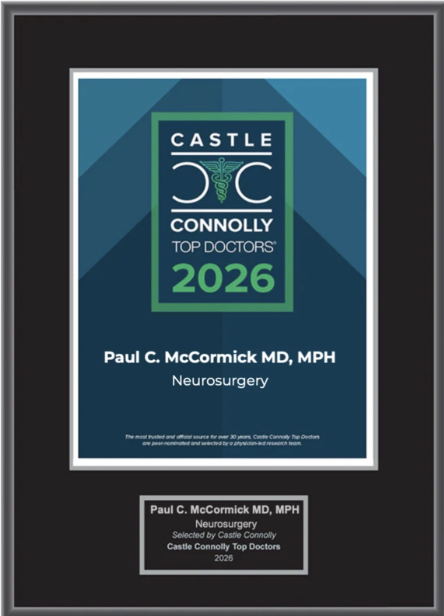
Dr. McCormick named as one of Castle Connolly’s Top United States and New York Doctors/Neurosurgery for 25 consecutive years.
| Header | Text |
| Summary | Cauda= a tail Cauda equina syndrome results from compression (squeezing) of the cauda equina–the sac of nerves and nerve roots at the base and just below the spinal cord in the lumbosacral spinal canal. It is a rare but serious disorder, and a medical emergency. The nerves of the cauda equina provide motor and sensory function to the legs and the bladder. Compression of these nerves can interrupt their function, and the effects can be severe. Cauda equina syndrome can lead to bladder and bowel dysfunction (loss of bladder/bowel control) and even permanent paralysis in the muscles of one or both legs. The cauda equina gets its name from the Latin words meaning “horse’s tail.” The sac of nerve roots has an appearance similar to a horse’s tail. |
| Symptoms | Cauda equina syndrome can cause a variety of symptoms, including:
Exact symptoms and their severity depend on which nerve root(s) are affected and the degree to which they are compressed. |
| Causes and Risk Factors | Cauda equina syndrome is most commonly caused by a massive disc herniation in the lumbar spine (low back). A disc herniation occurs when the jelly-like core of a disc herniates, or shifts out of position, putting pressure on nearby nerves in the spine. Herniated discs can occur with advanced age or can be caused by a spinal injury. Cauda equina syndrome can also be caused by trauma, a spinal tumor, spinal stenosis or a severe infection. In rare cases, spinal stenosis and vertebral fractures from osteoporosis can lead to cauda equina syndrome. |
| Tests and Diagnosis | Cauda equina syndrome is difficult to diagnose. It is rare, and its early symptoms may be similar to symptoms of other conditions. In addition, symptoms associated with cauda equina syndrome may vary in intensity and evolve slowly over time. If a patient presents with symptoms associated with cauda equina syndrome, a doctor may order the following diagnostic procedures:
|
| Treatments | Cauda equina syndrome is a potential surgical emergency, and may require timely decompression surgery to reduce/remove the pressure on the nerve(s). Undergoing early surgery seems to offer the best chance for improvement of sensory and muscle function as well as bowel and bladder function. If left untreated, cauda equina syndrome can lead to permanent paralysis in the muscle of one or both legs and permanent loss of bladder/bowel control. An important thing to note is that following surgery, bladder function may take longer to improve than muscle function. Following surgery, the surgeon may prescribe certain medications to be given with intermittent self-catheterization of the bladder. These interventions can lead to a steady recovery and improvement of bladder and sphincter function for years after surgery. |
| Preparing for Your Appointment | Drs. Paul C. McCormick, Michael G. Kaiser, Peter D. Angevine, Alfred T. Ogden, Christopher E. Mandigo, Patrick C. Reid and Richard C.E. Anderson (Pediatric) are experts in treating cauda equina syndrome. They can also offer you a second opinion. |
Helpful Surgery Overviews
Dr. McCormick will choose the treatment method specific to each patient and situation. Some of the condition’s treatment options may be listed below.
Recent News
Dr. McCormick named as one of Castle Connolly’s Top United States and New York Doctors/Neurosurgery for 25 consecutive years.
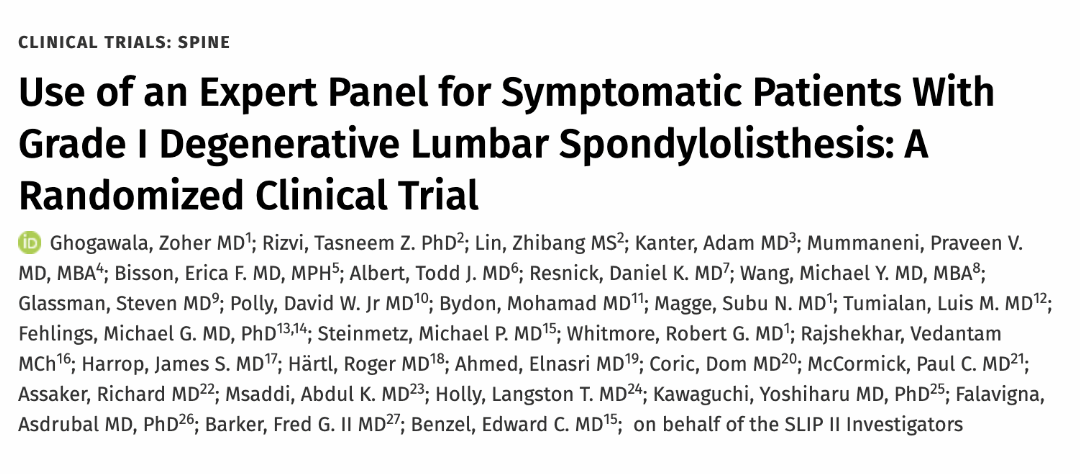
Dr. McCormick participated as both a member of the expert panel as well as a co-author of recently published randomized study on the treatment of grade 1 degenerative spondylolisthesis. This condition commonly occurs in adult patients and is subject to numerous types...

Dr. McCormick was invited to present his experience on the evaluation and microsurgical management of intramedullary spinal cord tumors. Dr. McCormick described his techniques and illustrated on video the safe and complete microsurgical resection of both an...