
Dr. McCormick named as one of Castle Connolly’s Top United States and New York Doctors/Neurosurgery for 25 consecutive years.
| Header | Text |
| Summary | Spinal dermoid and epidermoid cysts are benign growths in the spine. They are not cancerous and they will not spread. However, they may compress important structures like the spinal cord or spinal nerves, and they may eventually rupture. When they are found in the spine, therefore, these cysts are surgically removed. In medicine, a cyst is a hollow sac that contains something. Both dermoid and epidermoid cysts contain skin material. Both are lined with a layer of skin that naturally sheds dead cells. But instead of shedding to the outside of the body, the shed skin cells accumulate inside the cyst. In this way, the cysts gradually expand. Dermoid and epidermoid cysts differ in their other contents. Epidermoid cysts are lined with simple skin cells, and they contain only the products of skin cells (like the protein keratin) and an accumulation of shed skin cells. Dermoid cysts contain skin cells, their products, many other skin components (hair follicles, hair, or sweat glands, for example) and may also contain other material (tooth material, oil, or blood, for example). |
| Symptoms | In the spine, these cysts usually cause symptoms as they grow and compress nearby structures. Symptoms may include weakness, clumsiness, and pins-and-needles in the arms and legs, trouble walking, and incontinence. Exact symptoms depend on the cyst’s size and location. |
| Causes and Risk Factors | Dermoid and epidermoid cysts are rare overall, but are much more commonly diagnosed in children than in adults. They can be either congenital (present at birth) or iatrogenic (arising later in life as the result of a medical procedure).
|
| Tests and Diagnosis | Spinal dermoid and epidermoid cysts can be seen on imaging studies:
Spinal dermoid cysts may be associated with spinal abnormalities like spinal dysraphism, dermal sinus tract, spina bifida, spina bifida occulta, or myelomeningocele. Dermoid cysts may be discovered incidentally while diagnosing or treating those conditions. |
| Treatments | Microsurgical removal is the treatment of choice for most spinal cysts. In microsurgical removal, a surgeon uses a surgical microscope and very fine instruments to expose and remove the cyst. 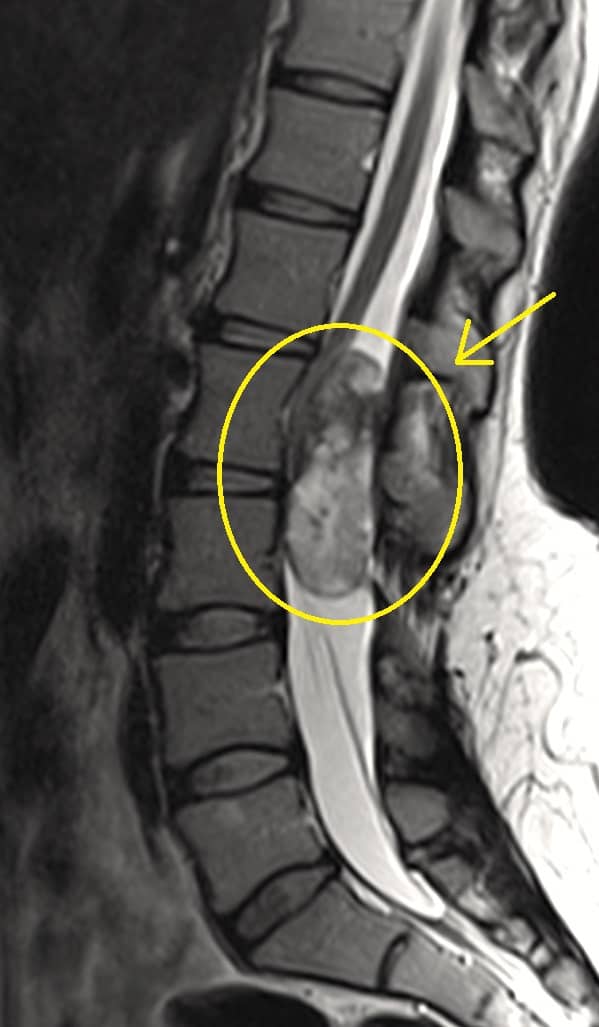 MRI of lumbar spine shows large dermoid tumor in the spinal canal putting severe pressure on the spinal cord and nerve roots. 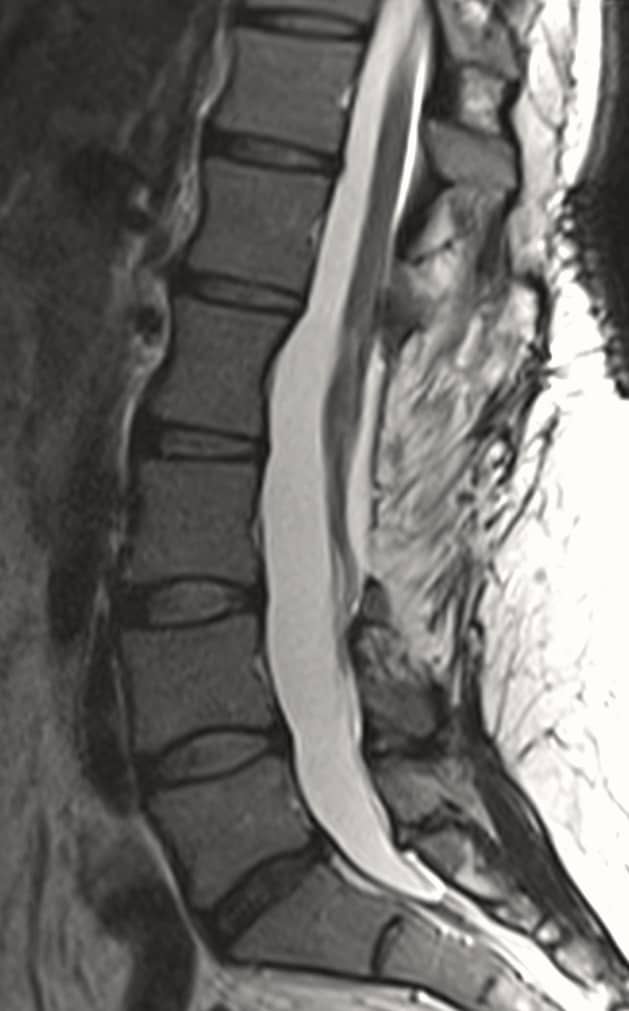 Post operative MRI following removal of the dermoid tumor by Dr. Paul C. McCormick at The Spine Hospital. Microsurgery to remove a dermoid or epidermoid spinal cyst is performed under general anesthesia (the patient is unconscious) with the patient positioned face-down. If the surgery will involve the spinal cord itself, spinal cord function is carefully monitored using precise electrophysiological techniques such as SSEP (somatosensory evoked potentials) and MEP (motor evoked potentials). A laminectomy, or removal of a portion of the back of the spine, is performed to gain access to the spinal canal. If necessary, the thin covering of the spinal canal known as the spinal dura is opened to expose the spinal cord, and a narrow opening in the back portion of the spinal cord may be made to expose the cyst. |
| Preparing for Your Appointment | Drs. Paul C. McCormick, Michael G. Kaiser, Peter D. Angevine, Alfred T. Ogden, Christopher E. Mandigo and Dr. Patrick C. Reid are experts in treating dermoid and epidermoid cysts. Drs. Richard C. E. Anderson (Pediatric) and Neil A. Feldstein (Pediatric) specializes in the treatment of these cysts in children. Any of our doctors can offer you a second opinion. |
Helpful Surgery Overviews
Dr. McCormick will choose the treatment method specific to each patient and situation. Some of the condition’s treatment options may be listed below.
Recent News
Dr. McCormick named as one of Castle Connolly’s Top United States and New York Doctors/Neurosurgery for 25 consecutive years.
Dr. McCormick participated as both a member of the expert panel as well as a co-author of recently published randomized study on the treatment of grade 1 degenerative spondylolisthesis. This condition commonly occurs in adult patients and is subject to numerous types...
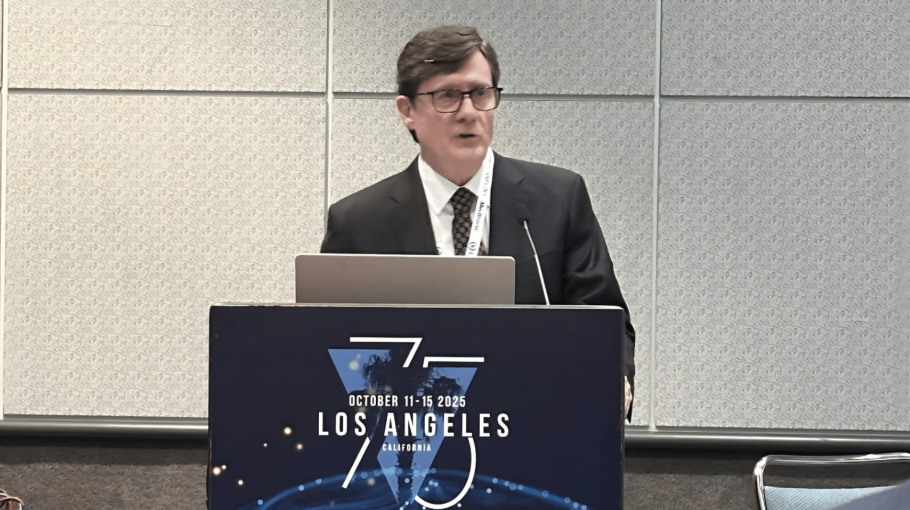
Dr. McCormick was invited to present his experience on the evaluation and microsurgical management of intramedullary spinal cord tumors. Dr. McCormick described his techniques and illustrated on video the safe and complete microsurgical resection of both an...