
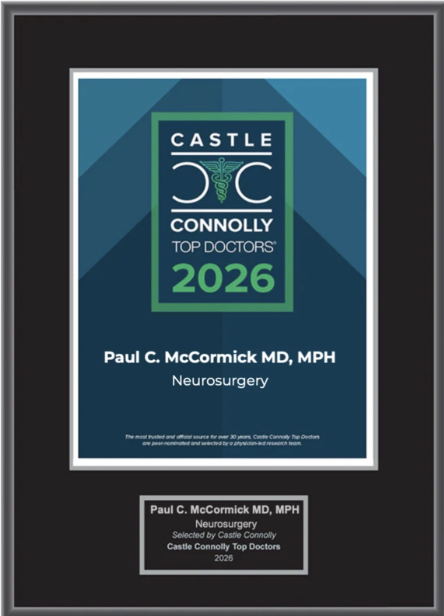
Dr. McCormick named as one of Castle Connolly’s Top United States and New York Doctors/Neurosurgery for 25 consecutive years.
| Header | Text |
| Summary | Hangman = a person who performs judicial (judge-ordered) hangings Hangman’s fracture is a break in a specific part of one bone in the neck. Bones of the spine are called vertebrae. The bone involved in hangman’s fracture is the second vertebra, toward the top of the neck, close to the skull. It is designated as C2: “C” for its location in the cervical spine (spine in the neck), and “2” for its position as the second bone in that spinal segment. C2 is also called the axis. Like every bone in the spine, C2 is made of two main sections. One is a strong, solid, cylindrical part called the body. The other is an arch of bone, called the lamina, which encloses the spinal canal and protects the spinal cord.There is a projection of bone that connects the body to the lamina, known as the pars interarticularis. In a hangman’s fracture, the pars of C2 fractures, or breaks, on both sides. At the same time, the C2 body may move out of position relative to the vertebra below, C3. This is the type of fracture supposedly created by judicial hangings. |
| Symptoms | The most common symptom of hangman’s fracture is neck pain following a fall or motor vehicle accident. However, if the trauma has caused other damage to the body, the neck pain may not be immediately noticed. Therefore, prompt medical evaluation is necessary after any such trauma. The most important concern with hangman’s fracture is injury to the spinal cord. In many cases, the spinal cord escapes injury when hangman’s fracture occurs. At the moment of impact, a hangman’s fracture results in increased space surrounding the spinal cord, thus avoiding immediate compression and injury to the spinal cord. This is a fairly unique feature of this injury. However, the fracture can be very unstable. Without treatment, the bones may shift, leading to increasing deformity that can result in serious damage to the spinal cord or progressive pain. If the spinal cord is damaged, symptoms can include pain, sensory loss, weakness, paralysis, and/or death. |
| Causes and Risk Factors | Hangman’s fracture happens when the head is snapped up and back with great force, which is known as a hyperextension injury. The most common causes of this injury are falls and car accidents. Some sports injuries or collisions can also cause this fracture. |
| Tests and Diagnosis | When hangman’s fracture is a result of major trauma, it is usually found as part of a patient’s evaluation in the emergency department.
|
| Treatments | The goals of treatment are to protect the spinal cord and restore spinal alignment and stability. Several treatment options are available. In some cases, immobilization and bracing can allow the fracture to heal on its own. However, if the fracture is unstable, surgical intervention is often considered the best choice. Surgeons can restore proper spinal alignment and fix the spine in place with wires, plates, and/or screws. Most patients do quite well with treatment. |
| Preparing for Your Appointment | Drs. Paul C. McCormick, Michael G. Kaiser, Peter D. Angevine, Alfred T. Ogden, Christopher E. Mandigo, Patrick C. Reid and Richard C.E. Anderson (Pediatric) are experts in treating traumatic spinal conditions such as hangman’s fracture. They can also offer you a second opinion. |
Helpful Surgery Overviews
Dr. McCormick will choose the treatment method specific to each patient and situation. Some of the condition’s treatment options may be listed below.
Recent News
Dr. McCormick named as one of Castle Connolly’s Top United States and New York Doctors/Neurosurgery for 25 consecutive years.
Dr. McCormick participated as both a member of the expert panel as well as a co-author of recently published randomized study on the treatment of grade 1 degenerative spondylolisthesis. This condition commonly occurs in adult patients and is subject to numerous types...
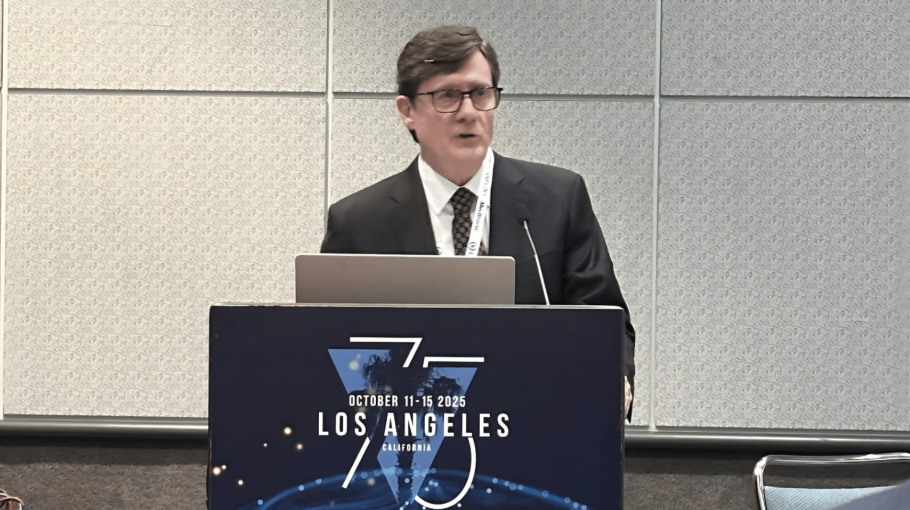
Dr. McCormick was invited to present his experience on the evaluation and microsurgical management of intramedullary spinal cord tumors. Dr. McCormick described his techniques and illustrated on video the safe and complete microsurgical resection of both an...